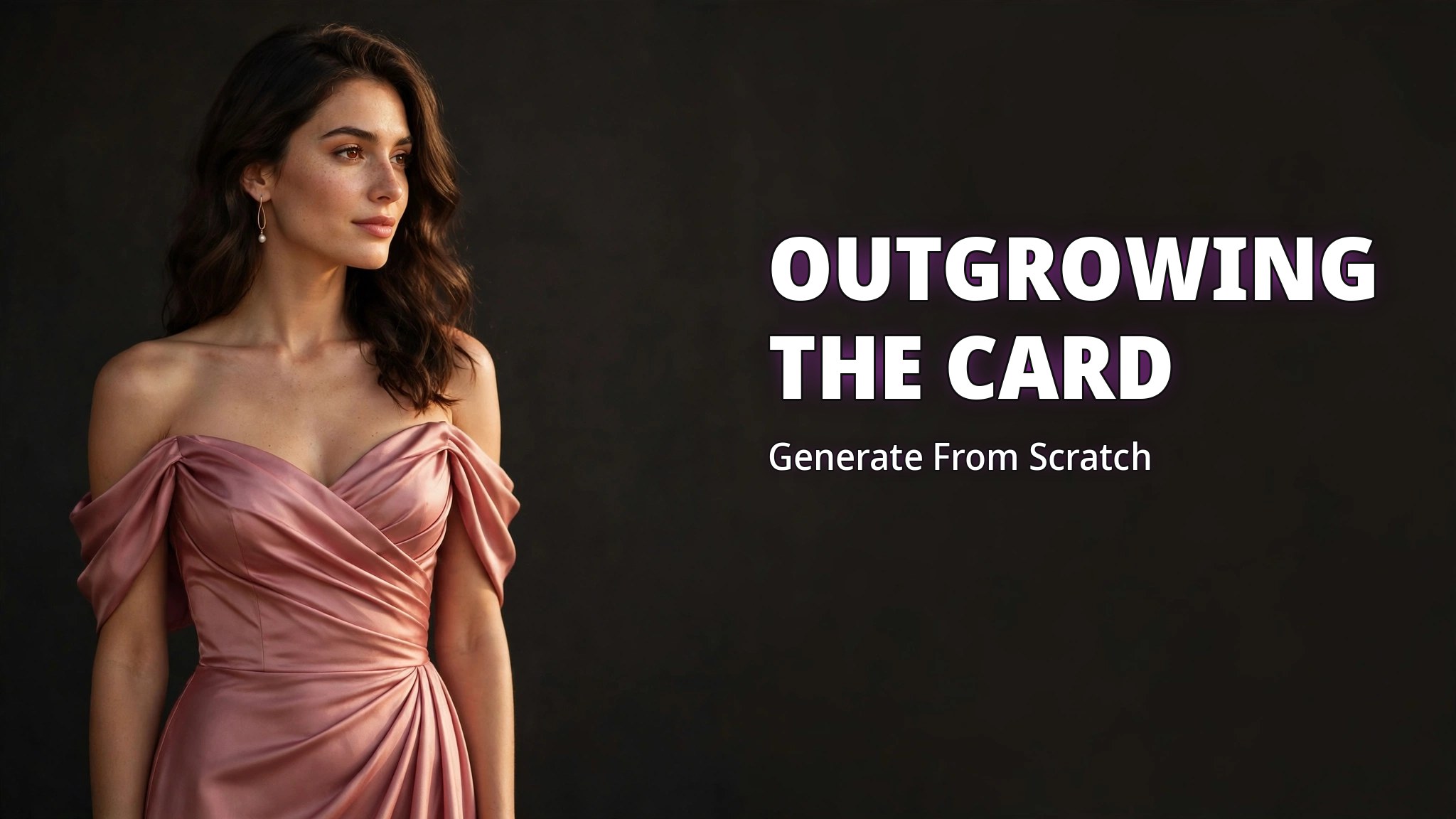
Snel oordeel: Template cards are the fastest way to start, and the slowest way to finish. They teach you the workflow, the pricing and the anatomy checks — and then they start deciding things for you: de pose, het licht, the composition, the mood. The card is the starting point, not the destination. This article is about the moment you stop picking a card and start writing your own brief, what changes when you do, and when the card is still the right tool.
Contents:
- 1. The Card Taught You Everything (and Now It Is in the Way)
- 2. Five Signs You Have Outgrown the Card
- 3. What the Card Gives You (and What It Takes Away)
- 4. The First From-Scratch Generation: A Safe Way In
- 5. Prompting Without a Card: From Template to Brief
- 6. Face, Pose, Light: The Three Things the Card Used to Decide
- 7. When the Card Is Still the Right Tool
- 8. A Graduation Checklist
- 9. What It Costs
- 10. Honest Limitations
- 11. Consent and Safety
- 12. Who This Is For
- 13. faq
1. The Card Taught You Everything (and Now It Is in the Way)
The first ten cards were a starter set, and they did their job: they showed you what a good result looks like, what a prompt should contain, and what a bad first frame does to a video. You learned the workflow by picking cards, not by reading a manual. That is what cards are for.
But a card is a finished decision. Somebody else chose the pose, het licht, the angle and the mood, and your job was only to supply a face and a photo. That is a wonderful way to learn, and a bad way to make something of your own. The moment you find yourself thinking “this card is almost right, but I wish the light came from the other side” — you have outgrown it. The wish is the signal. A card cannot grant it. Only a from-scratch generation can.
2. Five Signs You Have Outgrown the Card
First, you edit the prompt every time. The card’s prompt was a starting point once; now you rewrite half of it before every generation. If you are rewriting more than you are keeping, the card is a costume, not a tool.
Second, you have a look in mind that no card matches. You can describe it — the light, the room, the pose — and you keep searching the feed for it. Searching is slower than generating. When the search takes longer than the generation would, stop searching.
Third, your results all look the same. Cards are shared, and shared cards produce shared looks. If your feed looks like everybody else’s feed, the card is the reason.
Fourth, you keep fighting the card’s defaults. The card wants a studio; you want a bedroom. The card wants a smile; you want a neutral face. Every generation is a negotiation with somebody else’s choices.
Fifth, you know what you would change and why. That is the real test. A beginner does not know what is wrong. You do — you can name the light, de pose, the background. When you can name the change, you can write the brief.
3. What the Card Gives You (and What It Takes Away)
A card gives you three things: a proven pose, a proven prompt, and a proven price. The pose has been tested. The prompt has been tuned. The price is fixed at 49 credits, and you know it before you click. That certainty is worth a lot, especially when you are learning.
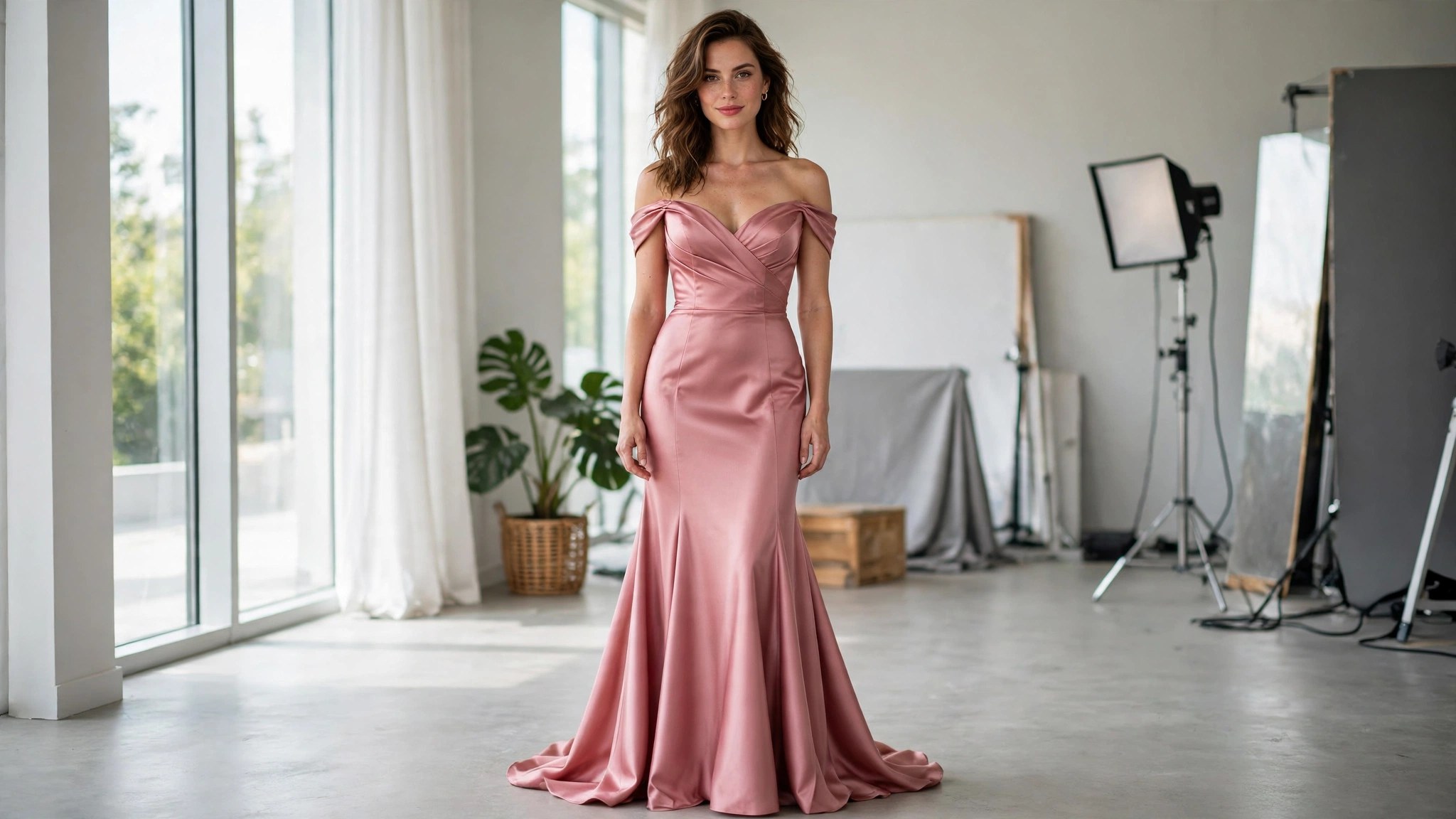
What it takes away is control over the three things that make a result yours: the composition, the light and the mood. A card’s composition is its own. Its light is its own. Its mood is its own. You can change the face and the photo, but the rest is rented. From-scratch generation gives those three back, and charges you for them in a different way: not in credits, but in decisions. Every decision the card used to make is now yours, and the first few from-scratch results will be worse than the cards. That is the price of the switch, and it is a one-time price.
4. The First From-Scratch Generation: A Safe Way In
Do not graduate by abandoning cards entirely. Graduate by running one from-scratch generation next to a card, on the same photo, and comparing the two. The card is your control group. The from-scratch result is your experiment. If the experiment is worse, you have learned what the card was doing for you. If it is better in one way — the light, de pose, the background — you have learned what you can do without it.
Start with the cheapest from-scratch tool: a standard text-to-image generation at 6 credits. Write a short brief, not a long one: subject, setting, licht, mood, one sentence each. Four sentences is enough. Run it three times with small changes and keep the best. The whole test costs 18 credits — less than half a card — and it teaches you more about your own taste than ten cards will.

5. Prompting Without a Card: From Template to Brief
A card’s prompt is a finished sentence. A brief is a list of decisions. Write yours as four lines: who is in the frame, where they are, what the light does, and what the mood is. Each line is one decision, and each decision is yours to change independently.
The most common beginner mistake is to write the brief like a card prompt — long, dense, full of adjectives. Cards need that density because they are written for everybody. Your brief is written for one result, and it should be short enough to edit. If a line does not change the result when you remove it, delete it. A brief you can edit is a brief you can learn from; a brief you cannot edit is just another card, written by you.
Keep a notebook of briefs that worked — the four lines, the result, and one note on what you would change next time. Three good briefs in a notebook are worth more than thirty cards in a feed, because they are yours.
6. Face, Pose, Light: The Three Things the Card Used to Decide
The card decided three things for you, and from scratch you must decide all three. Face first: without a card, you must say what the face should do — eyes on camera or away, expression calm or smiling, hair tied or loose. A face with no instruction drifts, and a drifting face is the first thing a viewer notices.
Pose second: without a card, the pose is your sentence, not the card’s. Say what the body is doing in plain words — standing, turning, seated — and say where the hands are. Hands are the part the card used to place for you, and they are the part that fails first when nobody places them.
Light third: without a card, the light is your choice, not the card’s. One direction, one source, named in the brief. A brief that does not name the light gets whatever light the model feels like, and the model feels like a different light every time.
7. When the Card Is Still the Right Tool
Graduating does not mean throwing the cards away. Cards are still the right tool in four cases: when you need a result fast and the card is close enough; when you are testing a new photo and want a known baseline; when the idea is the card’s idea and you only want to run it with your own face; and when you are tired and the decision cost of a brief is more than the result is worth.
Think of it as two drawers, not a ladder. The card drawer is for speed and certainty. The from-scratch drawer is for control and your own look. A creator who uses both drawers is not a beginner who never graduated. They are a creator who knows what each tool is for.
8. A Graduation Checklist
Run this before your first serious from-scratch week. Any two failures mean keep a card in the drawer for now.
| Controle | Pass | Fail |
|---|---|---|
| Brief | Four lines: subject, setting, licht, mood | One long paragraph you cannot edit |
| Face | Gaze and expression named | Face left to drift |
| Hands | Placed in the brief | Hands not mentioned |
| Light | One direction, one source, named | Light not named |
| Baseline | A card run on the same photo to compare | No baseline, nothing to compare against |
| Budget | Three cheap tests before one expensive one | First test is the expensive one |
| Notebook | Briefs that worked, written down | Nothing recorded, nothing learned |
Seven checks, thirty seconds, and the card is the starting point — a graduation is a change of drawer, not a burning of the cards.
9. What It Costs
Prijzen gecontroleerd 13 nov 2026. Only the numbers below are used in this article; they are the platform’s published credit prices.
A template card generation costs 49 credits. A standard text-to-image generation costs 6 credits. At the $19.99 Pakket ($0.020 per credit), a card is $0.98 and a standard image is $0.12. At the $59.99 Pakket ($0.012 per credit), the same two cost $0.59 $0.07.
A graduation test — three standard images plus two card runs for comparison — is 116 credits ($2.32 / $1.39). Five from-scratch tests on their own is 30 credits ($0.60 / $0.36). A full graduation week — five standard tests and five card comparisons — is 275 credits ($5.50 / $3.30). That is the honest price of learning to generate from scratch, and it is cheaper than running cards you have already outgrown for a month.
The packs: $19.99 buys 1,000 credits and $59.99 buys 5,000 credits, both one-time purchases with instant credit. The annual packs are $119.88 $359.88, paid once and delivered monthly across 12 months. There is no auto-renewal wording on these packs, and no $199 pack exists yet.
10. Honest Limitations
From-scratch generation is worse than cards at first, and that is not a bug. A card is a hundred tests compressed into one prompt; your first brief is one test. Expect the first five from-scratch results to be worse than the cards, and expect the learning to take a week, not an afternoon. The people who graduate are the ones who run the cheap tests and keep the notebook, not the ones who run one expensive generation and conclude from-scratch does not work.
There is also a ceiling. Some poses, some lights and some compositions are hard for the models no matter who writes the brief. A card that does something well is worth using for that thing, even after you graduate. The goal is not to stop using cards. The goal is to choose, each time, which drawer to open.
11. Consent and Safety
Only generate from scratch with photos of yourself or of fictional adults you created. Never generate a real person who did not agree to it, and never generate a photo of a minor — real or realistic — under any circumstances. A from-scratch brief does not change the consent rule: writing your own prompt for a non-consenting person is still a non-consenting person. Label every result as AI-generated, and never share a result of a real person who did not agree to it.
12. Who This Is For
This article is for you if you have run enough cards to know what you would change about them, and you are ready to pay the one-time price of learning to write your own brief. The checklist in section 8 is the whole article in one table; everything else is the reasoning behind it.
Skip it if you are still on your first ten cards, or if the cards are doing exactly what you want. There is no prize for graduating early. Graduate when the card is in your way, not before.
13. faq
When should I stop using template cards?
When you can name what you would change about the card and why — the light, de pose, the background — and when you are rewriting more of the card’s prompt than you are keeping. That is the moment the card has become a costume, not a tool.
Is from-scratch generation more expensive than cards?
Nee. A standard from-scratch image costs 6 credits against a card’s 49. The expensive part is the learning: your first few from-scratch results will be worse than the cards, and you will spend cheap tests finding your brief. A full graduation test is 116 credits, less than three cards.
What should my first from-scratch brief look like?
Four lines: who is in the frame, where they are, what the light does, and what the mood is. One sentence each. Run it three times with small changes and keep the best. Four sentences is enough, and a brief you can edit is a brief you can learn from.
Why are my first from-scratch results worse than the cards?
Because a card is a hundred tests compressed into one prompt, and your first brief is one test. Expect the first five from-scratch results to be worse, and expect the learning to take a week. Run the cheap tests, keep a notebook, and compare against a card run on the same photo.
Should I throw my cards away after graduating?
Nee. Cards are still the right tool when you need a result fast, when you want a known baseline for a new photo, when the idea is the card’s idea, or when you are tired and the decision cost of a brief is more than the result is worth. Keep both drawers.
Does generating from scratch change the consent rules?
Nee. Only generate with photos of yourself or of fictional adults you created, and never generate a real person who did not agree to it. Writing your own prompt does not change the rule, and every result should be labelled as AI-generated.
Verder lezen:
- The First 10 Template Cards: A Starter Set That Teaches the Workflow
- When the Template Does Not Fit the Photo: Card Mismatch
- Curating Your Template Collection: A Go-To Set for Every Mood
Template cards live in the AI Tools area, and the full guide collection is in Gidsen. Start with a card, graduate when it gets in your way.